
Ben Nevis in April: What Weather and Conditions to Expect When Climbing the UK’s Highest Mountain
The second half of March and all of April must be my favourite time of year in the Scottish Highlands, and in particular, on Ben Nevis. The days are long, the sun is often shining and the shorter, dark days of December and January are long forgotten. It’s possible to do just about any outdoor activity that you can think of on the surrounding mountains and lochs. From ice climbing and winter walking on Ben Nevis, rock climbing in Glen Nevis, skiing at Nevis Range, mountain biking in the woods, hillwalking in Glencoe, sea kayaking on the west coast and river kayaking, we can do it all at this time of year in Lochaber, the Outdoor Capital of the UK.

April 2018
That all said, it’s worth remembering that the weather and conditions underfoot can still change very rapidly, and being prepared and aware whilst enjoying any outdoor activity is paramount to staying safe. This is particularly pertinent whilst hiking up the mountain track (AKA the tourist path) on Ben Nevis in April, which at 1345m, is by far and away the highest mountain in the United Kingdom.
Snow on Ben Nevis in April
It is very rare for the upper half of Ben Nevis to be snow free in April. Given a cold, clear night, this snow can quickly transform to firm ice, presenting a steep and very slippery surface for hill walkers. In these conditions, it is essential to wear proper crampons, which have 8-10 large spikes or teeth per foot, designed to penetrate the ice and snow, and offer grip. You will also need to ensure that your boots are stiff enough to take a crampon. Micro-spikes or crampons with tiny teeth are not designed for this terrain, and so should be avoided. An ice axe should also be carried. The purpose of an ice axe is to act as a braking tool should you slip. It is important to know how to use an ice axe as a braking tool, otherwise, carrying it is fairly pointless. I often find myself using a trekking pole in my downhill hand and ice axe in my uphill hand. Crampons and an ice axe should be deployed earlier rather than later, and only put away once no more steep snow is to be encountered.

Firm snow on the zig-zags
The snow on the summit plateau is currently over a meter thick, and as a result many of the navigational cairns (5 foot piles of rock, built on the otherwise featureless plateau, to aid with navigating safely to and from the summit), are almost entirely buried. The plateau itself is a hostile place, with steep cliffs and corries either side of it. The mountain track passes very close to these steep edges, and so it’s vitally important to ‘get it right’. The visibility can vary from 50km+ down to a handful of meters in an alarmingly short space of time (as little as a few seconds), and therefore knowing precisely where you are on the plateau all of the time is essential. Make sure that you have a good map, such as those produced by Harveys and the British Mountaineering Council, and a descent Silva or Suunto Compass. Again, make sure that you know how to use this equipment! You can find a good article on navigating up and down Ben Nevis on UKHillwalking.
Snow can linger on the plateau well into July, and in some years, beyond.
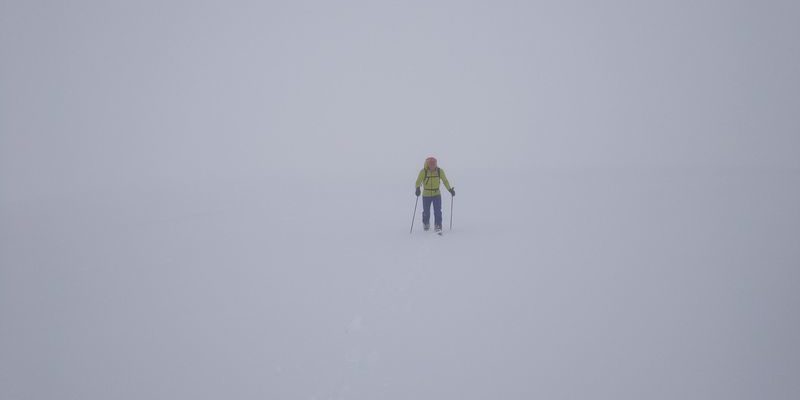
Poor visibility on the summit
Weather on Ben Nevis in April
The weather on Ben Nevis in April can vary hugely, from summer-like sunshine, through to driving rain and wind as well as freezing temperatures and full winter blizzards. It can be just as rewarding reaching the summit of Ben Nevis on a cloudless, bluebird day, as it is battling through wind and heavy snow, but whatever the conditions, they shouldn’t come as a surprise, and so you should be fully prepared for whatever the weather gods choose to throw at you. And preparation can also mean making the tough decision to turn around. Remember the mountain will always be there…
Even with the best of forecasts, it would be unwise to head up Ben Nevis in April without full winter clothing and gear. This includes a decent waterproof jacket and trousers, warm layers, hat and gloves, sunglasses and/or ski goggles, as well as the aforementioned crampons and ice axe.
The following websites for Ben Nevis weather are: MWIS, the Met Office and Snow Forecast.
What About Avalanches on Ben Nevis?
Avalanches are deadly and somewhat unpredictable, however, due to the prevailing winds and weather in April, it is unlikely that you will encounter avalanche prone terrain, if you stick to the mountain track. That’s not to say it definitely won’t happen, so always check the Scottish Avalanche Information Service before heading out. The nature of our prevailing westerly and south-westerly winds often mean that the snow is transported from the side of the mountain that the mountain track is on, and deposited on the far steeper north face of the mountain. However, if the winds swing round to northerlies or north-easterlies, this could quickly increase the avalanche hazard on the mountain track.
One hazard that is almost always present in winter, is the formation of cornices above the steep cliffs of the north face. Cornices are overhanging (and fragile) features of snow, that can easily collapse with the additional weight of a person. It can be far too easy to step onto one without realising it, so again, giving the edge of the plateau a wide berth is essential.
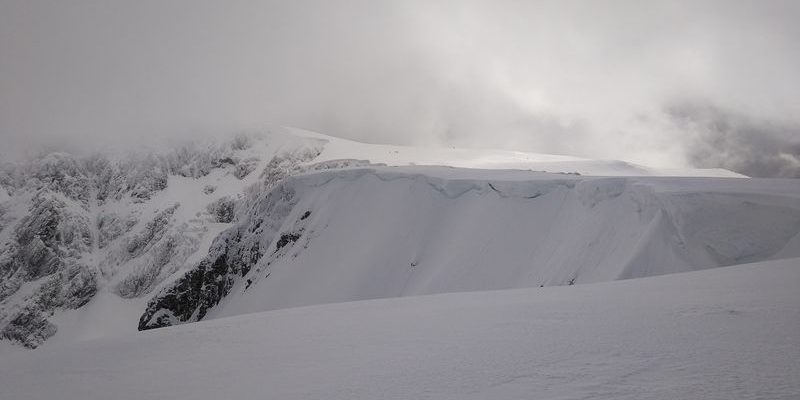
Cornices above the north face
What time should I start hiking if attempting Ben Nevis in April?
With the days in April being light until at least 8:30 pm, you can afford a slightly more relaxed start. Personally, I prefer to adopt the mantra ‘start early, finish early’ at any time of the year. I would try to get going by 8 am at the latest. Regardless of the time of the year, it’s still important to carry a head torch. See our blog post on ‘How long it takes to climb Ben Nevis‘ for further information.

On the summit

